Reposition agroecology as a coordinated investment system
The launch note frames agroecology not as isolated projects, but as coordinated territorial investment systems capable of transforming food systems at scale.
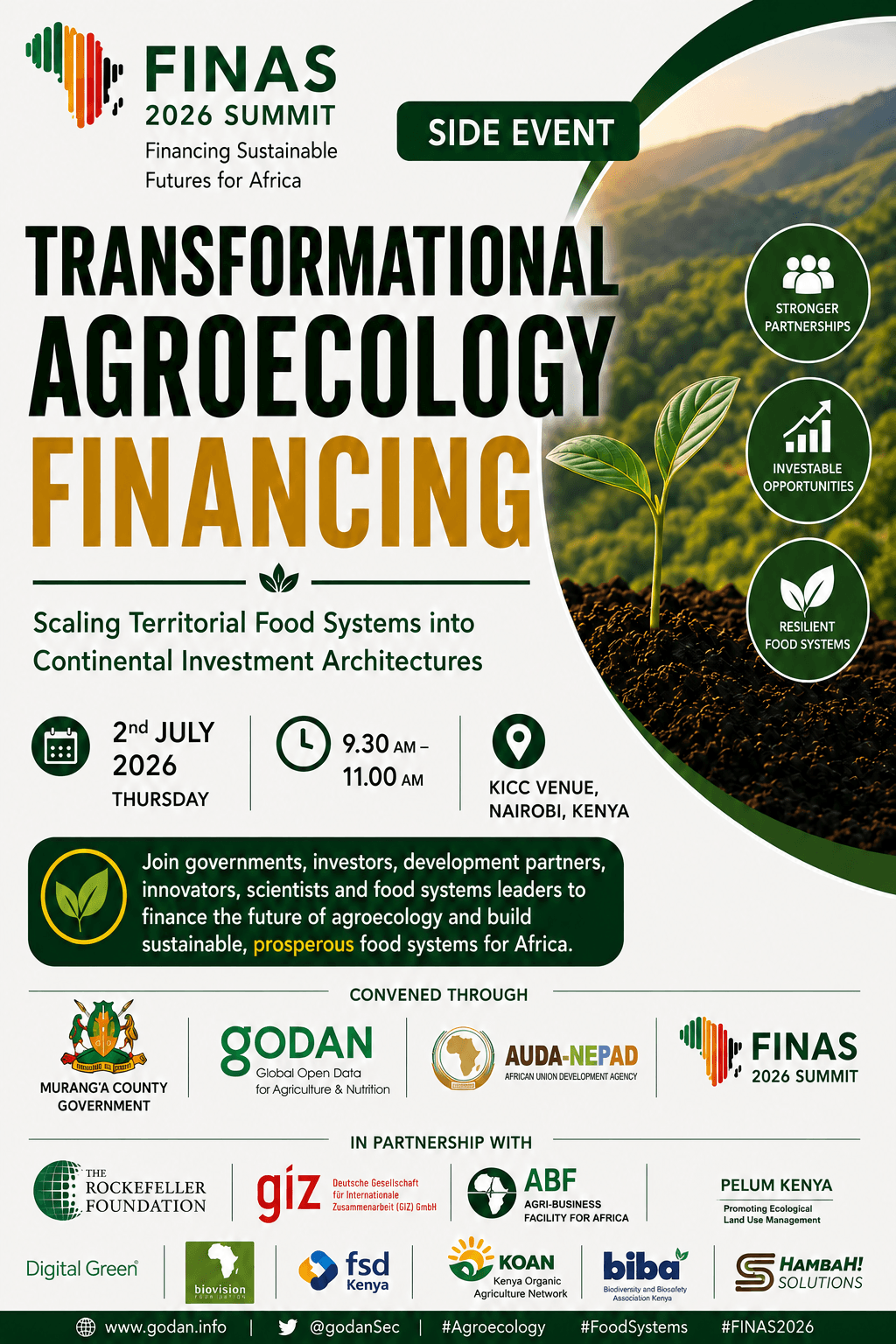
FINAS 2026 side event
A policy-to-investment platform connecting agroecology, digital public infrastructure, and place-based finance around the Murang'a lighthouse.
Event date
2nd July 2026, Thursday
9:30 to 11.00 AM
Location
Nairobi, with Murang'a as the operating territory
Convened through
Murang'a County Government, GODAN, AUDA-NEPAD, and FINAS 2026 Summit Partners
For policymakers
See what the compact asks of territorial and national authorities, and how implementation is organized.
For investors
Read the finance and de-risking storyline, then move into the agenda moments shaping investable systems.
For implementation partners
Follow the pavilion and signatory sections to understand how enterprises, researchers, and networks plug in.
Strategic frame
The Compact overview defines agroecology as a practical pathway for food systems transformation, moving from scattered pilots to territorial systems and from declarations to measurable transformation.
The launch note frames agroecology not as isolated projects, but as coordinated territorial investment systems capable of transforming food systems at scale.
The Compact links territorial platforms, enterprise hubs, FoodFarmacy systems, regenerative school meals, digital public infrastructure, and implementation learning into one architecture.
The Compact is written as a living implementation paradigm with annual accountability, investment alignment, and practical institutional roles.
Editorial moment
“From local transformation to continental investment architectures” is not a slogan. It is the implementation instruction written into this founding edition.
The compact reframes agroecology as a coordinated investment, governance, and accountability system where territorial delivery, finance instruments, and open digital infrastructure are designed to move together.
Founding focus
Murang'a as the operational lighthouse for multi-actor territorial implementation.
Programme architecture
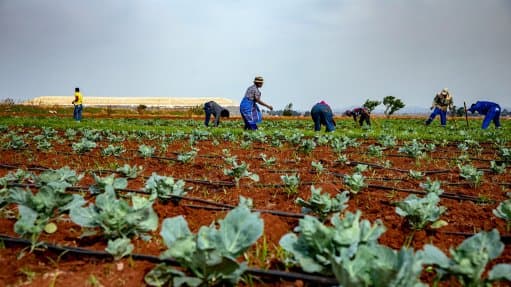
This agenda brings governments, investors, development partners, innovators, scientists, grassroots organizations, and food systems actors into one side event and Agroecology Pavilion focused on practical alignment and next-step action.
Featured moment
The official launch note positions Murang'a County as the Global Agroecology Lighthouse, where policy innovation, digital public infrastructure, youth enterprise, investment readiness, and multi-stakeholder partnerships converge.
H.E. Dr. Irungu Kang'ata
Murang'a County Government
Betty Kibaara
Rockefeller Foundation
Dr. Bernard Agbo and Hudson Aluvanze
GIZ Ghana / ABF and AUDA-NEPAD
Rosinah Mbenya
PELUM Kenya
Alex Mwaura
Digital Green
Francis Shivonje
Biovision Foundation
H.E. Dr. Irungu Kang'ata
Murang'a County Government
Moderator-led
Rockefeller Foundation
Jared Ochieng
FSD Kenya
The Agroecology Pavilion is described in the proposal as a practical demonstration platform aligned with the 13 Agroecology Principles and GODAN's 6Ps of People, Planet, Prosperity, Peace, Partnerships, and Participation.


Murang'a County and GODAN
Digital public infrastructure, traceability, FoodFarmacies, and FarmHub coordination for place-based delivery.
Rockefeller Foundation, PELUM, and KOAN
School meals and nutrition-linked procurement that create demand for regenerative production and local value chains.
Biovision Foundation
Evidence, coordination, and transition governance that help institutional partners back agroecology with confidence.
Digital Green and Ycenter Shambah Solutions
AI extension, soil intelligence, and interoperable data systems that shorten the path from field insight to decision-making.
BIBA Kenya and producer networks
Food sovereignty, indigenous seeds, and farmer-led coalition work that keeps the compact grounded in real territorial adoption.
Compact architecture
At FINAS 2026, the Compact sets a shared action plan for governments, investors, researchers, enterprises, and community partners. It aligns roles, funding pathways, and accountability so territorial agroecology can move from commitments to delivery.
Compact relationship diagram
Read left to right, then down. Public leadership and finance alignment enable territorial execution; field evidence then loops back into policy and investment decisions.
Policy and governance
National and territorial authorities set mandates, procurement logic, and governance guardrails.
Finance and enterprise
Investors and finance partners structure de-risking, blended pathways, and enterprise readiness.
Science and digital public infrastructure
Research, geospatial systems, and open data provide verification, monitoring, and interoperability.
Territorial delivery engine
Farmers, producer organizations, youth enterprises, nutrition actors, and civil society execute programs in real food systems.
Accountability loop
Implementation evidence and annual reporting feed back into policy refinement and investment allocation.
Priority tracks in the founding edition
Counties, municipalities, landscapes, communities, and local food systems are treated as the practical spaces where agroecology must be organized, financed, monitored, and scaled.
The Compact ties territorial implementation to sustainable financial architectures, trusted data, enterprise development, blended finance, and public policy.
Purpose areas named in the document include youth and women enterprise development, regenerative school meals, FoodFarmacy systems, and local enterprise growth.
The Compact positions open data, digital public infrastructure, trusted data governance, research, implementation learning, and annual accountability as core operating instruments.
These chambers carry policy legitimacy, territorial coordination, and the public authority needed to anchor implementation in real places.
These chambers organize capital, enterprise pathways, and innovation pipelines so agroecology can scale beyond pilot logic.
These chambers ensure the compact remains rooted in farmers, food systems outcomes, health, and community participation rather than institutional abstraction.
For policymakers
Use the compact as a practical coordination framework to align county-national mandates, procurement pathways, open-data accountability, and cross-sector implementation roles.
For investors
The compact surfaces investable territorial pipelines by linking de-risking mechanisms, enterprise readiness, digital verification, and demand-led regenerative markets.
FINAS 2026 closes with a clear invitation: join the Compact, take a defined role, and co-build implementation pipelines that can be financed, measured, and scaled across territories.
Authoritative signals
From local transformation to continental investment architectures.
Agroecology moved from scattered pilots to territorial systems.
Compact framed as a living implementation paradigm.